
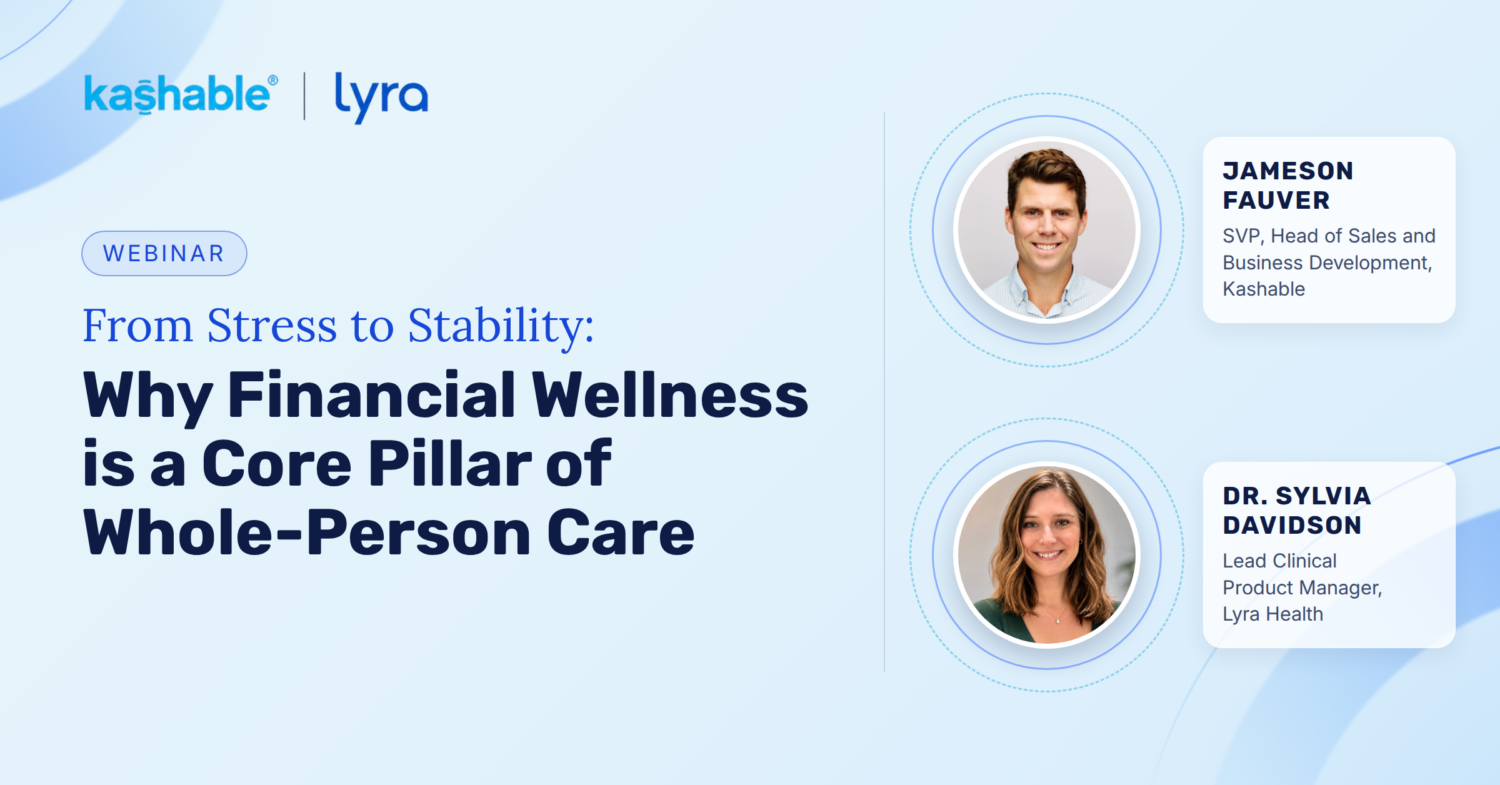
Financial stress doesn’t stay in an employee’s bank account. It can affect their mental health, productivity, relationships, and overall wellbeing.
Yet many employers still address financial wellness and mental health through separate benefits programs, leaving employees to navigate overlapping challenges on their own.
During Kashable and Lyra Health’s recent webinar, “From Stress to Stability: Why Financial Wellness Is a Core Pillar of Whole-Person Care,” Jameson Fauver, SVP, Head of Sales and Business Development at Kashable, and Dr. Sylvia Davidson, Lead Clinical Product Manager at Lyra Health, explored why employers need a more connected approach.
Financial Stress is More Than a Money Problem
Financial hardship can contribute to anxiety, depression, distraction, and feelings of helplessness.
Davidson explained that these challenges frequently emerge in clinical settings, where employees may blame themselves for financial circumstances beyond their control.
“We can’t just therapy somebody out of a real material crisis,” she emphasized.
Mental health care can help employees manage emotional challenges, but it cannot eliminate an unpaid medical bill or repair a broken-down car.
As Davidson explained, “You can create the best clinical plan in the world, but if a person is struggling to meet core needs, the plan falls apart.”
For employers, addressing financial stress means recognizing the real-world challenges contributing to it and providing practical solutions.
Employees Need More Than Financial Education
That’s where many financial wellness strategies fall short. Employers have invested heavily in retirement planning, financial education, and coaching, but these resources don’t always address immediate financial challenges.
“Coaching or financial rehab isn’t going to help you get the car out of the shop so you can get to work,” Fauver noted.
He compared financial wellness to treating a broken arm: Immediate care addresses the injury, while rehabilitation supports long-term recovery.
Similarly, responsible credit can help employees manage urgent expenses, while financial coaching and education support longer-term stability.
The goal isn’t to encourage borrowing. It’s to provide responsible options when financial needs arise.
Financial Vulnerability Crosses Income Levels
And those needs aren’t limited to lower-income employees.
“High income doesn’t necessarily mean financial liquidity,” Fauver explained. He referred to Goldman Sachs’ Retirement Survey & Insights Report from last year, which shows that 41% of workers making over $300,000 a year say they are living paycheck to paycheck.
He compared an employee earning $30,000 facing a $1,500 car repair with someone earning $300,000 facing a $20,000 roof repair. Both may lack readily available funds despite vastly different salaries.
Their access to affordable¹ credit may also differ significantly.
For HR and benefits leaders, this reinforces the importance of offering inclusive financial wellness resources across income levels and credit profiles.
Financial Support Has Value Beyond Utilization
Another key takeaway: Employees can benefit from knowing financial support is available, even if they never use it.
Fauver described employees checking their potential loan options simply to understand what might be available during an emergency.
That sense of preparedness can offer peace of mind.
As Davidson noted, “We can give them options. They can feel like they’ve got some breathing room.”
For employers, this suggests financial wellness benefits may provide value beyond traditional utilization metrics.
Building a More Connected Benefits Strategy
The overlap between Lyra Health and Kashable demonstrates how different benefits can complement one another.
Lyra provides clinical mental health support, while Kashable offers access to Socially Responsible Credit®, payroll-aligned repayment, financial coaching, free credit monitoring, and financial education.
As Fauver summarized, “It’s about providing that right resource to the right employee at the right moment.”
For CHROs, HR leaders, benefits administrators, and brokers, the takeaway is clear: Whole-person care requires supporting employees through immediate financial challenges while helping them work toward long-term stability.
Learn how Kashable can strengthen your organization’s financial wellness strategy at Kashable.com.
1 – APR for loans through Kashable ranges from 6% to 35.99%. To qualify for the lowest rate, applicants must have a responsible credit history. Employment, income, and other factors are taken into consideration. Not all applicants will be approved.
This blog is for general informational purposes only and does not constitute legal, financial, or credit advice.
Personal loans offered through the Kashable branded Loan Program are subject to approval, are not deposit products, and may be originated either by Kashable LLC (NMLS ID 1373339) or by one of Kashable’s lending partners. For additional information regarding lending partners, visit kashable.com/lenders.
